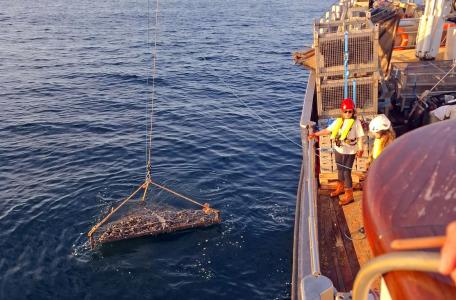
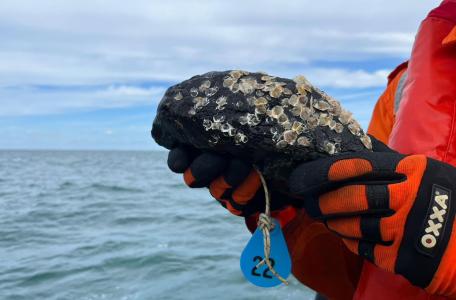
Oesters en mosselen zijn biobouwers. Schelp op schelp ontstaan er stevige riffen waar heel veel andere soorten van profiteren. ARK Rewilding Nederland heeft de afgelopen jaren ervaring opgedaan met het aanjagen van dit natuurlijke proces en is er klaar voor om dit op nog veel grotere schaal te doen.
Feiten en cijfers
1
Ooit was de Nederlandse Noordzeebodem voor 30 procent bedenkt met riffen. Nu is dat 1 procent.
2
Op schelpdierriffen in de Noordzee komen wel 60% meer soorten voor dan op de omringende zandbodem.
3
Schelpdierriffen filteren het water en maken dat helderder. Hierdoor kan zonlicht dieper in het water doordringen en kan er meer fytoplankton groeien = meer eten in de voedselketen.
4
Vele zeedieren zijn een deel van hun levenscyclus afhankelijk van riffen, als paaiplaats, voor voedsel, om eieren op af te zetten, om op te groeien of als schuilplaats voor roofdieren.
5
Grote roofvissen houden zeesterren en zeeëgels die schelpdieren eten beperkt in aantal.
6
Voor de ecosysteemfunctie maakt het niet uit welke dieren een rif vormen: Japanse oester, Europese platte oester, mosselen, paardenmosselen of kokerwormen.
door bodemvisserij aangetaste zeebodem door © Peter van Rodijnen, Dutch Maritime Productions
platte oester en anemoon
Gezaagde steurgarnaal (Marion Haarsma)
Paganelgrondel Brouwersdam © Sanne Ploegart
hondshaai (Scyliorhinus canicula) © Peter Verhoog
Paarse kokerworm © Ad Aleman

Bron van leven

Oesters en mosselen groeien graag op en bij elkaar. Schelp op schelp. Zo ontstaan er stevige riffen waar heel veel andere soorten van profiteren. Om te eten, te schuilen, voort te planten, groot te groeien en als verblijfplaats te gebruiken. Wieren, sponzen, anemonen, zachte koralen, zeenaaktslakken, schelp- en schaaldieren, octopussen, zeekatten, allerlei vissoorten... Zo zijn schelpdierriffen hotspots voor de Noordzeenatuur: de soortenrijkdom is er veel hoger dan op naastgelegen zandige bodems.

Video URL
Belang van schelpdierriffen (www.onderwaterbeelden.nl)

Helder water

Oesters en mosselen filteren bovendien het zeewater. Het slik dat deze rifbouwers uitspugen maakt de bodem stabieler en het water wordt er helderder van. Zo kan het zonlicht dieper in het water schijnen, wat algen beter doet groeien. Van die algen kunnen veel andere soorten weer eten. Ook zorgen ze dat zichtjagende vissen en vogels hun prooi beter kunnen zien. 

Image
Platte oester. Foto: Ester van den Doel, Duiken in beeld

Nieuwe riffen

In de negentiende eeuw bestond de Noordzeebodem voor zo'n twintig tot dertig procent uit schelpdierriffen. Door overbevissing, industrie en scheepsvaart zijn ze nu bijna geheel verdwenen. Gelukkig kunnen riffen met hulp teruggroeien, bijvoorbeeld door oesters uit te zetten, stevig materiaal aan te bieden om op te groeien en bodemrust te creëren. 

Image
Schelpdierriffen zijn een hotspot voor vele dieren, zoals deze gestippelde mosdierslak. Foto: Sanne Ploegaert


Meer informatie

Kennislinks
Downloads

Partners

  • Postcode Loterij
  • European Union LIFE Programme
  • Natura 2000
  • Ministerie van Infrastructuur en Milieu
  • Logo provincie Zuid-Holland
  • LIFE IP Deltanatuur
  • Tal van dieren, zoals deze gezaagde steurgarnaal, profiteren van schelpdierriffen.
  • De aanleg van oesterriffen is goed voor allerlei bodembewoners zoals deze krab. Foto Ad Aleman

Wetenschappelijke bronnen

Ecological engineering with oysters enhances coastal resilience efforts

Leeswijzer
Ben jij benieuwd hoe oesters helpen de veerkracht van de kust te vergroten en daardoor meer veiligheid bieden tegen klimaatverandering en zeespiegelstijging? Lees dan dit artikel. Doordat oesterriffen ecologische, morfologische en sociaaleconomische ecosysteem diensten bieden is het van groot belang deze te herstellen.
Abstract
Coastal areas are especially vulnerable to habitat loss, sea-level rise, and other climate change effects. Oyster-dominated eco-engineered reefs have been promoted as integral components of engineered habitats enhancing coastal resilience through provision of numerous ecological, morphological, and socio-economic services. However, the assessed ‘success’ of these eco-engineered oyster reefs remains variable across projects and locations, with their general efficacy in promoting coastal resilience, along with related services, often mixed at best. Understanding factors influencing the success of these eco-engineered habitats as valuable coastal management tools could greatly inform related future efforts. Here, we review past studies incorporating reef-building oysters for coastal resilience and enhanced ecosystem services. Our aims are to better understand their utility and limitations, along with critical knowledge gaps to better advance future applicability. Success depends largely on site selection, informed by physical, chemical and biological factors, and adjacent habitats and bottom types. Better understanding of oyster metapopulation dynamics, tolerance and adaptation to changing conditions, and interactions with adjacent habitats will help to better identify suitable locations, and design more effective eco-engineered reefs. These eco-engineered reefs provide a useful tool to assist in developing coastal resilience in the face of climate change and sea level rise.

Experimental Disturbance-Induced Shifts in Benthic Functional Diversity: the importance of marine protected areas in soft-bottom ecosystems

Leeswijzer
Experimentele studie naar de invloed van bodemberoerende visserij in de Waddenzee die laat zien dat ook geringe verstoring duidelijk negatieve invloed heeft op het bodemleven van het Wad.
Abstract
Benthic communities form the foundation of food webs in coastal and shelf seas worldwide. However, these communities face severe threats from anthropogenic bottom-disturbing activities. Marine Protected Areas (MPAs) effectively safeguard benthic communities against such disturbances. Nevertheless, the effectiveness of MPAs for the recovery of benthic communities in highly dynamic soft-bottom areas is much debated, as these communities are thought to be adapted to natural dynamics and therefore resistant to human impacts. In this study, we examine whether MPAs in highly dynamic seas support sensitive communities that are affected by bottom-disturbing fishing gear. Utilising a Before-After-Control-Impact (BACI) experimental design, we investigated the effects of disturbance caused by a shrimp trawl gear on macrozoobenthic communities within MPAs in a dynamic coastal soft-bottom sea over two years. We assessed changes in taxonomic and functional diversity, as well as community composition, across three levels of trawling intensity and frequency (low intensity and high frequency, high intensity and low frequency, and high intensity and high frequency) compared with undisturbed control areas. The study was carried out in the lower dynamic areas of the study system, where we found that, even light trawling gear impacted functional diversity and community assembly of macrozoobenthic communities, leading to shifts in functional groups. Contrastingly, taxonomic diversity metrics were not affected. We found that taxonomic and functional turnover increased stronger over time than the undisturbed control, with the highest turnover in the most frequently disturbed treatments. Long-living species were negatively impacted by disturbance, and the abundance of scavengers and predators increased in trawled areas, with possible radiating effects into undisturbed areas, while suspension feeders declined. Our findings demonstrate that anthropogenic disturbance remains a relevant ecological pressure, even in areas that may appear resilient due to their dynamic nature. MPAs can then provide ecological benefits by protecting sensitive and functionally important species.

The Native Oyster Restoration Alliance (NORA) and the Berlin Oyster Recommendation: bringing back a key ecosystem engineer by developing and supporting best practice in Europe

Leeswijzer
Dit artikel benadrukt het belang van het samenbrengen van kennis en ervaring over het terugbrengen van de platte oester, voornamelijk in de Noordzee. Verschillende internationale projecten en samenwerkingen zetten zich in voor het habitatherstel van de platte oester door hun wetenschappelijke en praktijkkennis te delen. Dit artikel geeft een mooi overzicht van Europese landen en hun platte oesterprojecten die deel zijn van de “Native Oyster Restoration Alliance”.
Abstract
Efforts to restore the native oyster Ostrea edulis and its associated habitats are gaining momentum across Europe. Several projects are currently running or being planned. To maximize the success of these, it is crucial to draw on existing knowledge and experience in order to design, plan and implement restoration activities in a sustainable and constructive approach. For the development of best practice recommendations and to promote multidimensional knowledge and technology exchange, the Native Oyster Restoration Alliance (NORA) was formed by partners from science, technology, nature conservation, consultancies, commercial producers and policy-makers. The NORA network will enhance scientific and practical progress in flat oyster restoration, such as in project planning and permitting, seed oyster production, disease management and monitoring. It also focuses on joint funding opportunities and the potential development of national and international regulatory frameworks. The main motivation behind NORA is to facilitate the restoration of native oyster habitat within its historic biogeographic range in the North Sea and other European seas along with the associated ecosystem services; services such as enhancing biodiversity, including enhanced fish stocks, nutrient cycling and sediment stabilization. NORA members agreed on a set of joint recommendations and strongly advise that any restoration measure should respect and apply these recommendations: The Berlin Oyster Recommendation is presented here. It will help guide the development of the field by developing and applying best practice accordingly. NORA also aims to combine the outreach activities of local projects for improved community support and awareness and to provide educational material to increase knowledge of the key ecological role of this species and increase awareness among regulators, permit providers and stakeholders. A synthesis of O. edulis restoration efforts in Europe is provided and underlines the general significance in the field.